When it comes to choosing a T8 tube light the choices can be exhausting. In a competitive market there are countless options and choosing the right bulb will ultimately effect the mood and energy being given off by your entryway, hallways, offices, gathering spaces, common rooms etc.
Considering a building that has been renovated multiple times, refurbished countless times, and added/taken away from several times it may be time to consider singularity amidst what can evolve to be chaotic facilities maintenance and inventory.
In a world where anything can be ordered and delivered to your doorstep it can seem like a good idea to leave the warehouses of Amazon, Walmart, Home Depot, or Lowes to hold your items, but the truth is when it comes to maintaining and sustaining irresistible environments there is a critical need to have a reasonable amount of product in house. This does not mean to have thousands of lightbulbs on hand, but it can mean to hold a percentage worth. For example, if a floor of a building has 500 tubelights it may be worth it to hold about 5% worth that amount on hand in case of failures. So a case of 25 bulbs would be sufficient for the quick grab and go resolution.
Maintaining an updated inventory also allows the facilities personnel to respond quickly when needing to make orders prior to repairs or replacements, or even to prepare for larger electrical related projects.
Now, to talk about tube lights. T8 tube lights took over from the older T12 model saving both energy, maintenance costs, and radiation reduction. Fluorescent fixtures ruled the market for many years as troffer lights became common alongside drop ceilings in the average office/commercial space.
As 2005 came, along with smartphones and more common use of the internet, LED technologies emerged as fluorescent technology held the monopoly in the commercial construction supplies industry. As the years have gone by, the prices of LED have also gone…down. Nowadays, LED bulbs are close to the the price of fluorescent bulbs with no need for ballasts, and minimal needs for maintenance. Some LED bulbs, double, and even triple the life cycles of their comparative Fluorescent bulbs while also saving immense costs on utility bills which will make the accounting team/stakeholders ultimately happy.
Brands of popular tube lights range from Philips, Sylvania, PLT, Halco, Parmida, TCP, Luxrite and other less notorious but equal quality. Using a spreadsheet to compare costs, lumens, color, lifespan, and dimmability should be consulted with either a Facility Manager, Electrician, Designer, and/or a General Contractor to best fit application and needs of your facility.
When it comes to a specific property managed, there happens to be a large quantity of troffer lights mixing thirty years worth of different models of T8 and T12 fixtures. Considering a finite budget, there are several different approaches to maintaining and sustaining irresistible environments. One approach is to pay a large sum of money upfront to outsource all of the labor thus modernizing the entire building and campus to LED for immediate energy savings.
The other is to address the fixtures as they fail so to not be replacing fixtures that may potentially have a few months or years left in their life cycle. Considering the intent to be a good steward of budget and resources, it makes sense to address portions at a time as they show aging or functionality issue.
For example, if a hallway has five rooms and were all installed around the same time, but the adjacent hall was an add on to the building ten years later, then it can be assumed that the fixtures in the first hall will die before the fixtures in the adjacent hall or hallway two.
As the fixtures in hallway one begin failing it is in good practice to address one entire room at a time. Budgeting, record keeping, and time management become impossible if maintenance falls into the philosophy and practice of reactive maintenance. Ultimately the organization, owners, or stakeholders will be much happier to know that the unseen work of record keeping and asset protection is organized and thoughtful.
There are some fixtures that allow for integrated lighting where even light bulbs become obsolete, but the difficulty with managing those fixtures is that if the lights fail (and they will), or the driver fails due to a power surge, then the entire fixture has to be changed out which is extremely wasteful.
It is hard to fathom a world without light bulbs, and so when it comes to choosing and managing which type of tube light to use it is worth diving a little deeper. For reference, this post is specifically catering towards a 48 inch tube light with troffer light fixtures that will either fit one, two, three, or even four bulbs. These generations of fixtures may have compatibility with 32W to 40W ballast compatibility and also have either one, or two ballast if originally designed for fluorescent bulb application.
A ballast bypass is normal today as LED conversions sweep through commercial spaces. Ballasts were initially required for supplying the appropriate amount of energy from the panel to the fixture and through the light bulb, but nowadays a direct line into the fixture is possible due to the led driver technology.
Bypassing the ballast to a fixture, as long as the fixture is not blackened, or damaged from years of overheating and use, is recommended to cut down future maintenance costs, and to encourage the LED bulb whether type A, B, or Hybrid to function to its fullest.
Considering a building with several generations a fixtures, it makes the most sense to use a Hybrid LED bulb. This form of LED can work with or without a ballast, it can work whether one end is hot and the other neutral, or if both are tied into a single side. These bulbs are also compatible with almost any style of T8 Ballast, but if there are any hesitations or questions it is recommended to seek professional consultation with a licensed electrician.
The go to bulb when dealing with an older commercial building or frequently renovated campus is the Hybrid LED 48 inch tube light. When it comes to color, it is good to use a Cool White or 3900K-4200K temperature. Cool white gives off the most reflective spectrum of lighting without compromising those with sensitive eyesight. Daylight would be considered too strong for people who have such visual sensitivities.
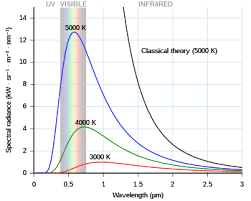
Planck’s Constant gives the best visual representation of why Cool White or 4000K seems to be the best representation for commercial lighting settings. It is professional, formal, and clean lighting that allows the colors of furniture, flooring, paint, and other fixtures to reflect their natural coloration. A soft white lighting is typically common and cheaper, but it does not allow the reflections of many unique colors that tend to draw people in and even assist in mood stabilization.
There are many accounts of designers, or managers who choose a wall color for their office because it is relaxing, but then end up in debates with the painter or Facility manager because, “it does not look right”, or “this is not the color I chose”. For most issues regarding a dislike in color choices it most of the time comes down to the lighting in the room. If the soft white yellowish light is reflecting across a light blue it will pull out greens that can be distasteful to some. This is not an attempt to be a designer, but simply a way to troubleshoot the root of common issues in coloring problems.
And so, when it comes to retrofitting a commercial building to LED while remaining conscious of a budget it is good to lean on singularity. That means singularity in the type of bulb, the type of color, and the type of lens. The preferred modern tube light would be a T8 Hybrid style LED bulb that will fit in about every fixture at a Cool White temperature. This will truly allow your facilities team to keep your facilities both immaculate and irresistible.
As always, God Bless,
James Arthur Ferguson
Below is a picture of a Parmida tube light and an image of Planck’s Constant.

 Strategic Management and Inspections of Facilities